Research
I study the dynamics of coastal circulation and tracer transport. I pursue these questions from estuaries to the shelf and open ocean, connecting coastal dynamics to biological and biogeochemical processes. My research spans Chesapeake Bay, the Salish Sea, the Northwest Atlantic, and increasingly the Texas coast and northern Gulf, using these contrasting environments as natural laboratories for understanding how circulation and transport vary across geometries, scales, and forcing regimes.
Circulation and physical controls
What organizes coastal circulation?
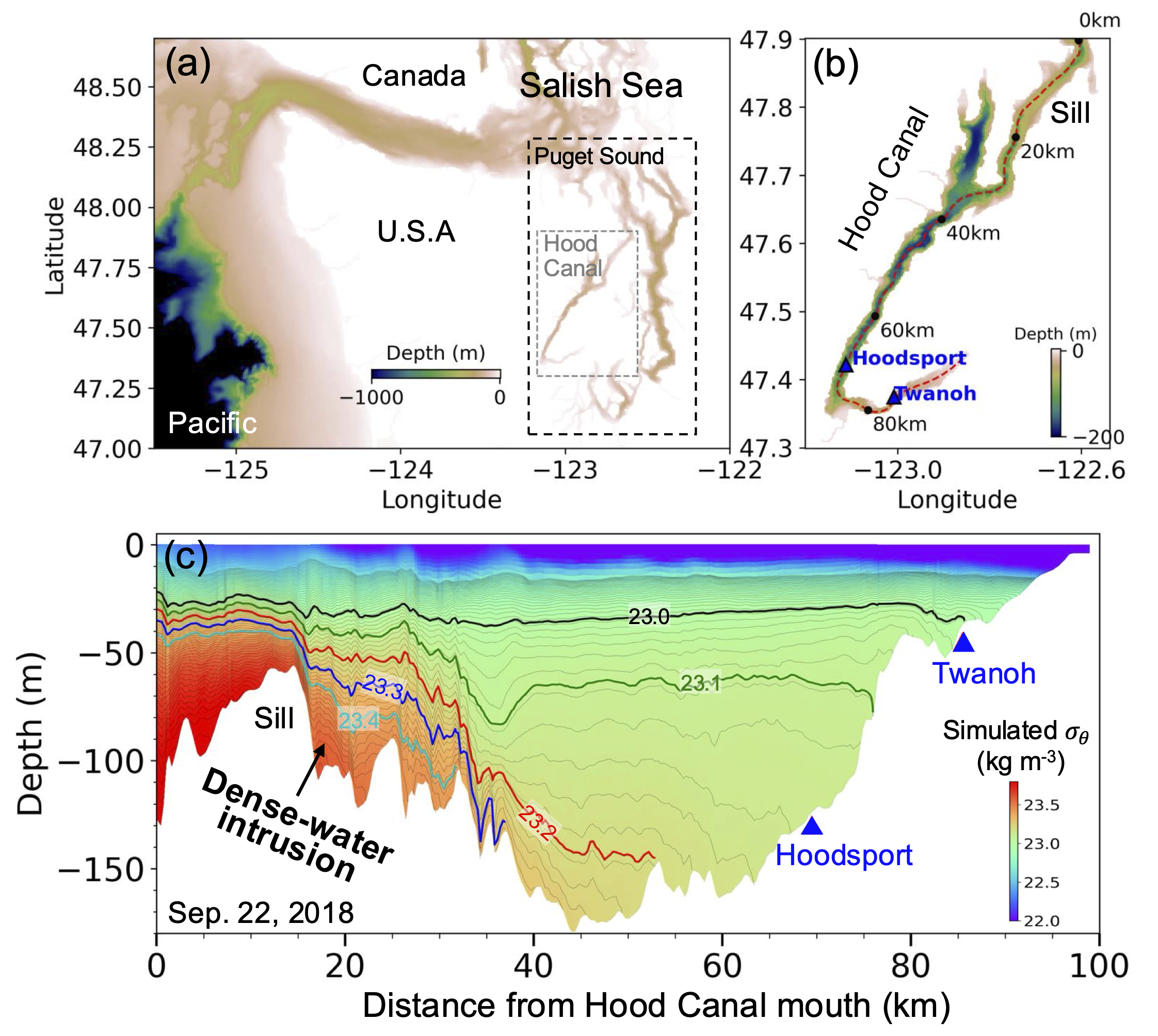 Seasonal dense-water intrusion in Hood Canal.
 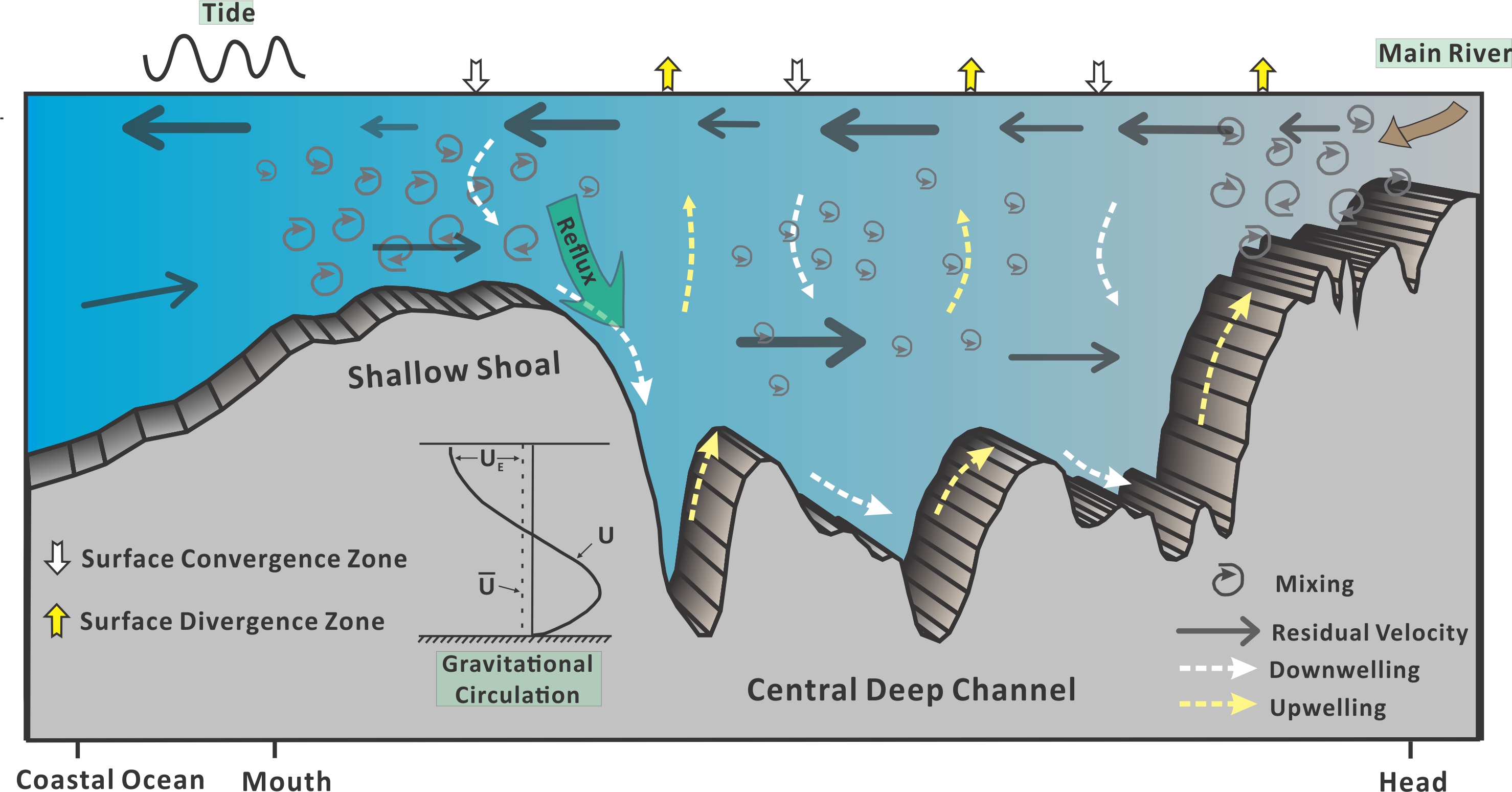 Exchange, reflux, and topographic controls in Chesapeake Bay. Coastal circulation emerges from interactions among external forcing, density structure, complex geometry, and mixing. I study how these interactions organize exchange and renewal, how the dominant dynamical balances vary across coastal environments, and why particular locations can exert disproportionate control on the larger circulation. My current work in Hood Canal investigates annual cycle of deep-water renewal: how dense oceanic water crosses complex topography and propagate through a strongly stratified fjord to ventilate the deep basin, and how the basin is progressively freshened and preconditioned for the next dense-water intrusion. My work in Chesapeake Bay showed how freshwater discharge and winds regulate exchange over long timescales, while complex bathymetry can reorganize circulation, enhance reflux, and increase material retention.
These studies motivate broader questions: How does complex geometry organize exchange? How do forcing, stratification, and bathymetry interact to control circulation and mixing? How do dominant dynamical balances vary across estuarine environments? Contrasting systems along the Texas coast provide new opportunities to investigate these questions.
Selected work
- Annual deepwater renewal in a fjord estuary: preconditioning, tidal pulsing, and dense-water intrusion (submitted)
- Exchange flow and material transport along the salinity gradient in a long estuary (JGR: Oceans, 2021)
- Water exchange and its relationship with external forcings and residence time in Chesapeake Bay (Journal of Marine Systems, 2021)
Fronts, transport, and connectivity
Where does material go, and how long does it stay?
Transport is rarely spatially uniform. Fronts, convergences, retention zones, eddies, and preferred pathways concentrate and redistribute water and tracers across coastal systems. I use Eulerian and Lagrangian perspectives together to understand where water comes from, where it goes, how long it remains, and what physical mechanisms create these pathways.
These questions extend naturally from estuaries to the continental shelf and open ocean. In the Northwest Atlantic, my modeling work examines how Gulf Stream variability, eddies, and fronts influence cross-shelf transport and exchange. I am particularly interested in how these dynamics control transport pathways, shelf residence times, and the exchange heat, salt, and freshwater between the shelf and open ocean.
Along the Texas coast and northern Gulf, the same transport questions arise at different scales: How are neighboring estuaries connected through the shelf? Where does the water entering individual estuaries come from? What controls transport pathways into and out of estuaries? How do episodic winds, river discharge, and storms interact with coastal geometry to shape this connectivity?
1 Following water and particles
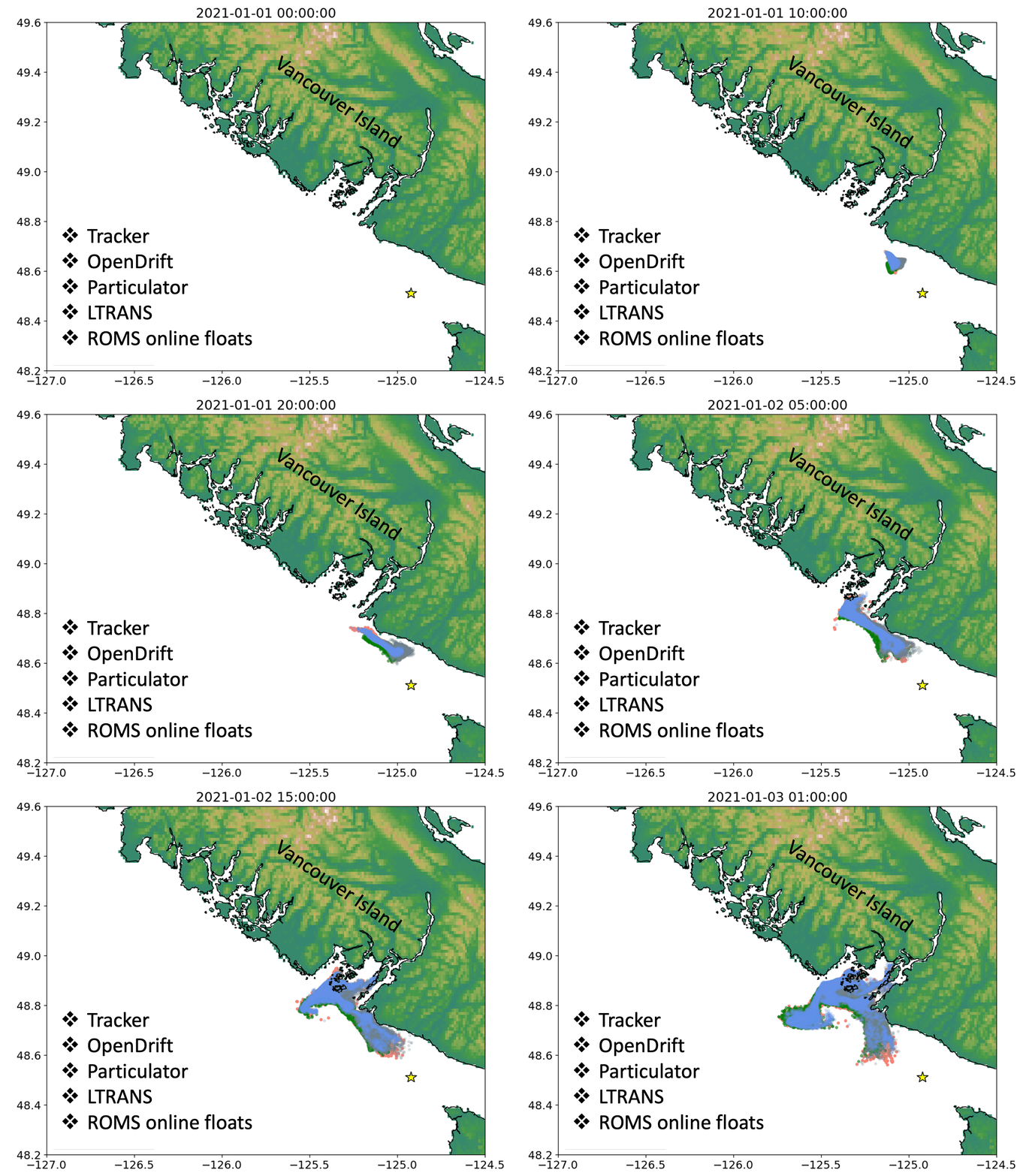
Lagrangian particle tracking provides a complementary view of circulation by following individual trajectories through evolving velocity fields. I use particle tracking not simply to visualize where material goes, but to diagnose the physical mechanisms that produce transport pathways, retention, and connectivity.
2 Putting a clock⏱ on transport
Transport is not only about where material goes, but also how long it spends along different parts of its pathway. Residence time, exposure time, water age, renewal time, and process-specific particle ages provide different clocks for quantifying transport.
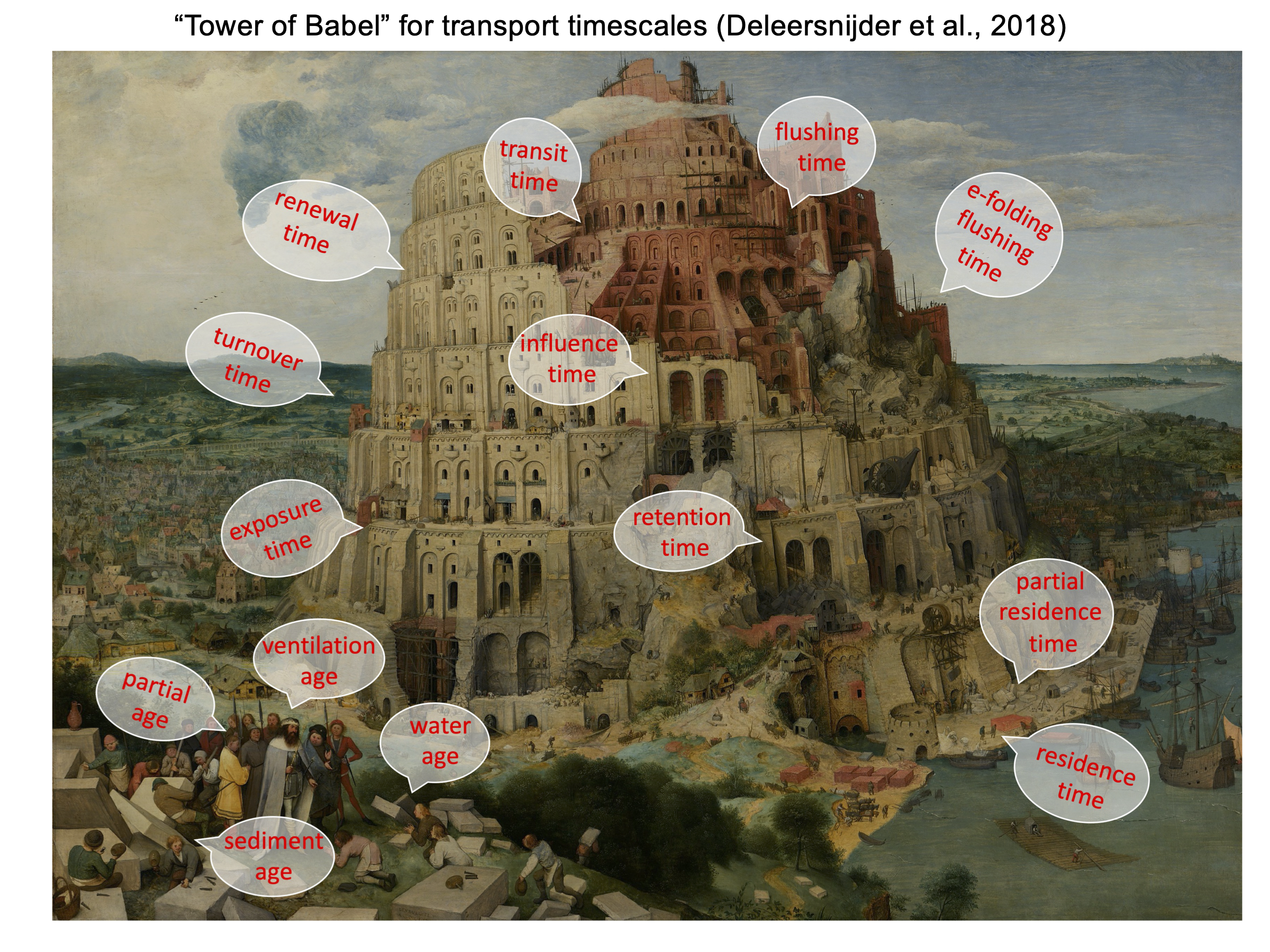
I use transport timescales to connect circulation with retention, renewal, and transformation. By attaching different virtual clocks to water parcels or particles, we can distinguish time spent in the water column, sediments, particular geographic regions, or other dynamically meaningful states.
These timescales provide a bridge between physical transport timescales and the timescales of biological and biogeochemical processes.
Selected work
- A mesoscale-eddy-resolving circulation model for the Northwest Atlantic and Gulf Stream: NWA5k-ROMS v1.0 (submitted)
- Intercomparisons of Tracker v1.1 and four other ocean particle-tracking software packages in the Regional Ocean Modeling System (Geoscientific Model Development, 2024)
- Vertical transport timescale of surface-produced particulate material in the Chesapeake Bay (JGR: Oceans, 2022)
- Water exchange and its relationship with external forcings and residence time in Chesapeake Bay (Journal of Marine Systems, 2021)
Physical–biogeochemical interactions
How does physical transport shape biological and biogeochemical tracers?
Different tracers do not experience the same circulation in the same way. Sinking, swimming, growth, mortality, degradation, deposition, and biological uptake interact with advection and mixing to alter transport pathways and accumulation. I study how these tracer-specific processes turn physical structures and transport pathways into biological and biogeochemical patterns. 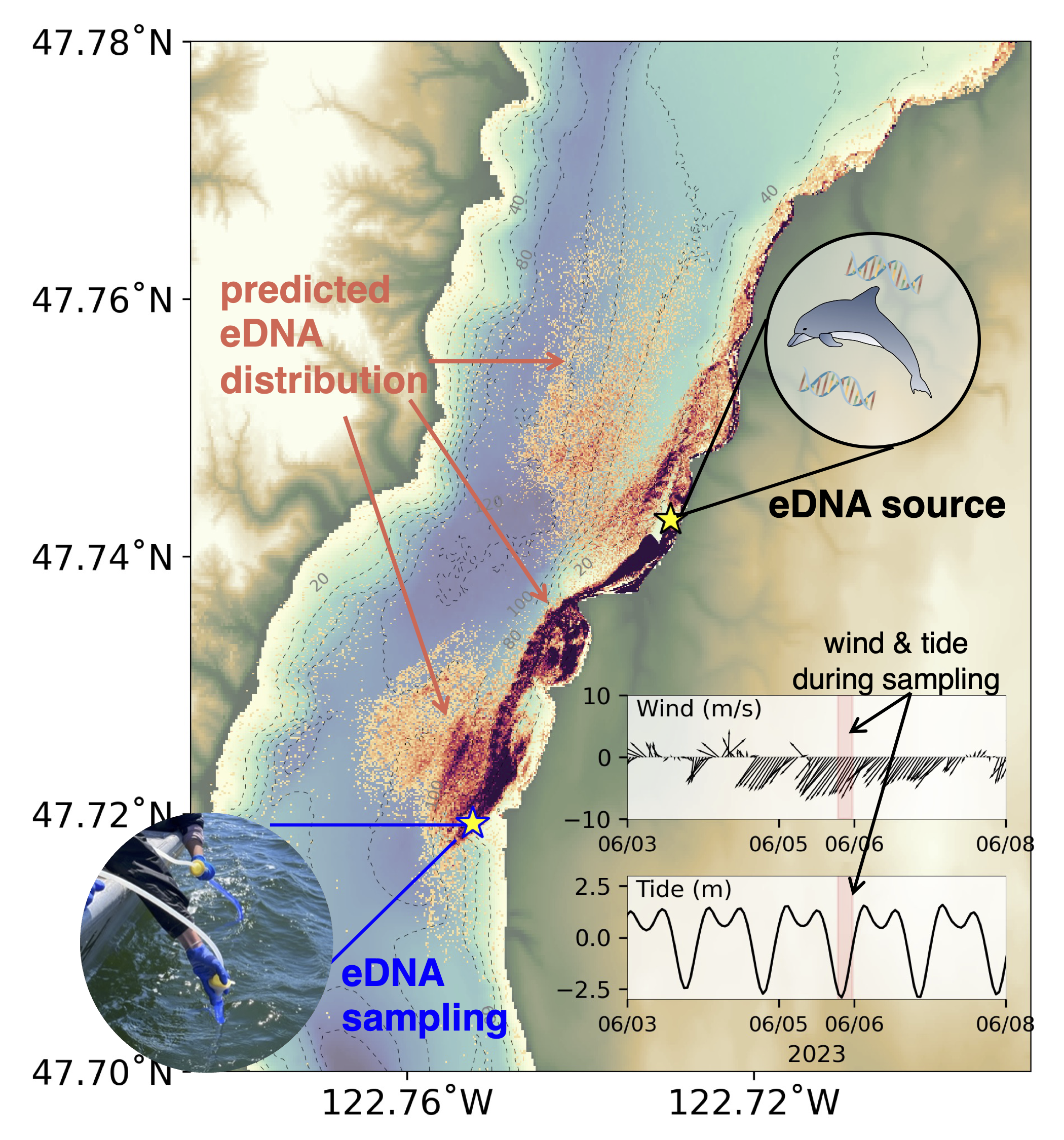 Modeled eDNA transport
1 From source to observed signal
Environmental DNA provides a direct example. An observed eDNA signal is not determined by source location alone: it reflects the integrated effects of advection, dilution, degradation, and sampling history. By combining hydrodynamic modeling, particle tracking, and observations, I investigate how physical transport shapes biological signals and how oceanographic information can improve ecological sampling and interpretation.
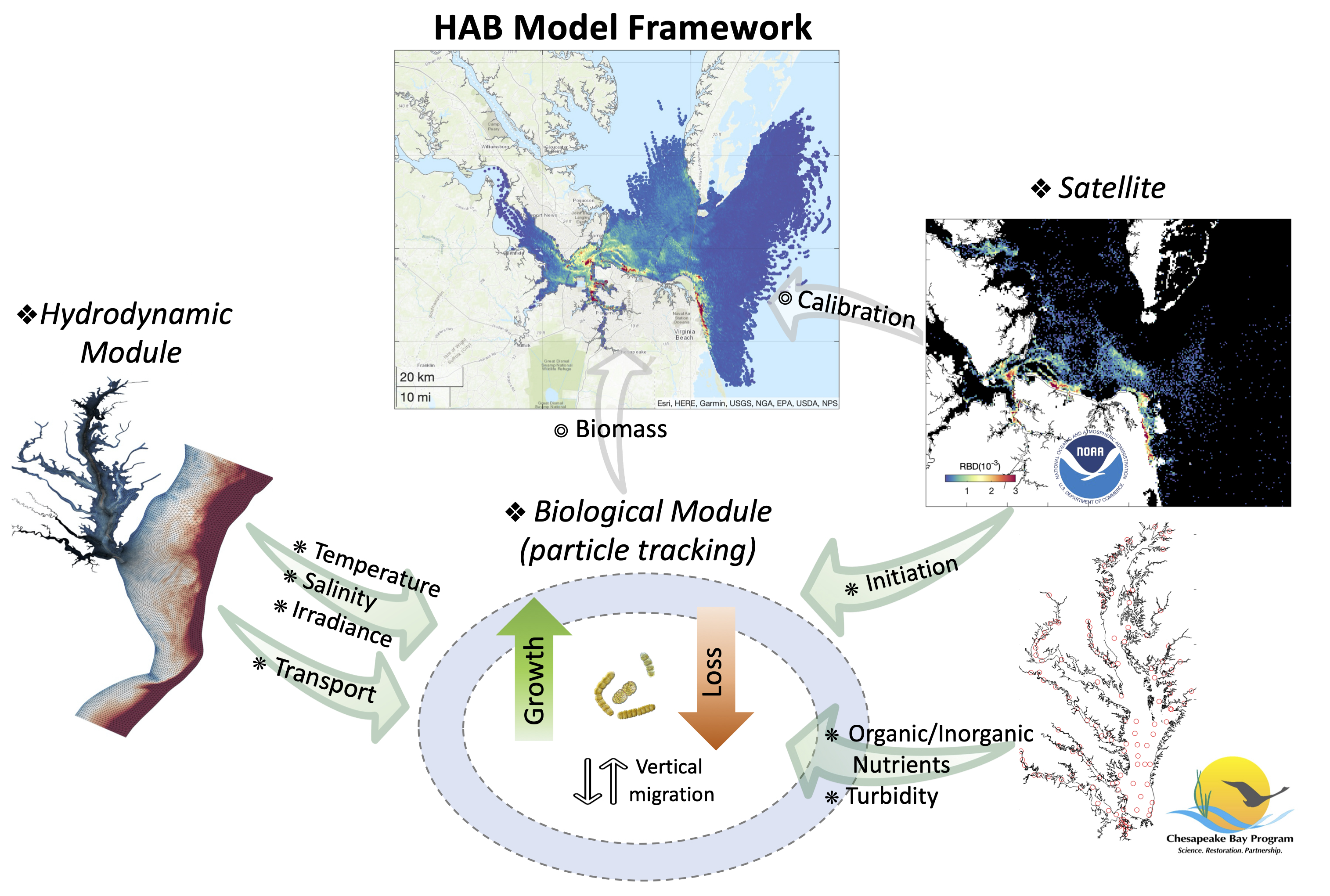 A biophysical model couples hydrodynamics with growth, loss, and vertical migration to simulate HABs
2 When transported particles are alive
For harmful algal blooms, transport interacts with organism behavior and population dynamics. I developed a coupled Lagrangian biophysical model that incorporates growth, respiration, mortality, and diel vertical migration along particle trajectories. This framework showed how biological behavior and physical transport work together to control bloom intensity, spatial extent, patchiness, and responses to storms.
3 From physical exchange to biogeochemical budgets
Physical circulation also regulates ecosystem-scale tracer budgets. 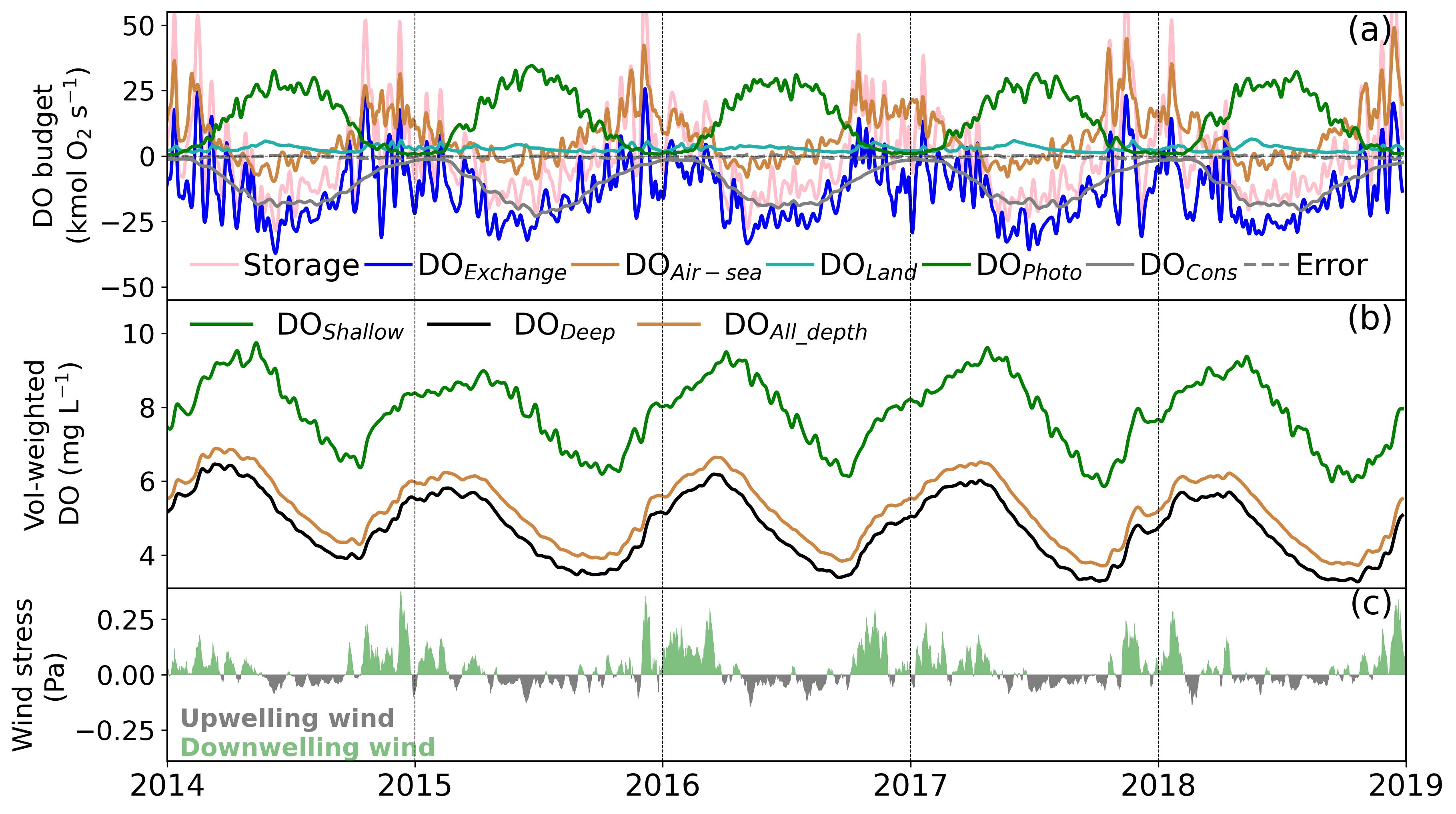 DO variability reflects the interaction between physical exchange and tracer-specific biological and air–sea sources and sinks. In the Salish Sea, I quantified how exchange flow interacts with atmospheric forcing, biological production and respiration, terrestrial inputs, and benthic processes to regulate heat, total nitrogen, and dissolved oxygen.
The broader question is how physical hotspots become biological and biogeochemical hotspots: how fronts, mixing regions, retention zones, renewal pathways, and exchange flows create environments where tracer concentrations and transformation rates differ sharply from their surroundings.
Selected work
- Advective transport drives environmental DNA dispersal in an estuary (Environmental Science & Technology, 2025)
- Impact of estuarine exchange flow on multi-tracer budgets in the Salish Sea (JGR: Oceans, 2025)
- Biophysical interactions control the progression of harmful algal blooms in Chesapeake Bay (Limnology and Oceanography Letters, 2023)
- Vertical transport timescale of surface-produced particulate material in the Chesapeake Bay (JGR: Oceans, 2022)
Across these questions, I seek a mechanistic understanding of coastal circulation and transport—how they vary across environments and forcing regimes, and how their effects propagate through physical, biogeochemical, and ecological systems.